Where Geology Meets History
The Torre Pietra Fortress House and the entire village owe their name to the word “pietra” (stone). The toponym most likely derives from the large erratic boulder on which the tower is entirely built.
This highly foresighted construction choice allowed the building to reach us intact, without structural damage, despite the passing of centuries and long periods of neglect. Building directly on a monolith of this size provided a solid foundation, which acts as a seismic damper: resting on the ground, the approximately 500-ton mass (equivalent to about 120 elephants or 350 cars) reduces the speed and intensity of seismic shocks, protecting the tower structure like a pendulum.
The South Facade
Originally, the fortress had no entrances on this side (facing the valley).
Instead of the current door, there was a loophole, now bricked up. The only original opening is the small trilithic window on the top floor, from which the valley entrance could be monitored. Just below the roof ridge is another small opening: this was used as an access point for carrier pigeons.
The Erratic Boulder: A Journey from 150,000 Years Ago
But what exactly is an erratic boulder?
It is a large rock block transported by ancient glaciers and deposited far from its place of origin. The boulder on which the tower stands is a monolith of Augen Gneiss, a rock characterized by visible light crystals (like quartz). This rock likely comes from the Gran Paradiso massif in the upper Valle Orco.
About 150,000 years ago, a massive glacier descended from the Orco and Soana valleys, reaching about 600 meters above sea level. During its slow, unstoppable descent, it plucked enormous rock blocks from the mountain slopes, incorporating them into the ice mass and transporting them downstream over millennia. As the ice gradually melted, these boulders were deposited on the valley floors and slopes, forming the morainic landscape we see today.
Erratic Boulders in the Torre Pietra Area
Even today, thousands of years later, many erratic boulders remain in front of the tower, in surrounding woods, on the slopes of Monte Belice, and among the mountain villages of Faiallo, Nava, and Navetta, as well as throughout the Valle Orco and Soana.
In the past, their number was certainly greater. Over the centuries, inhabitants used them as building material for houses, dry-stone walls, paths, and terraces for cultivation. Even the village of Torre Pietra was built using blocks from these erratic boulders.
Traces of the Ancient Glacier
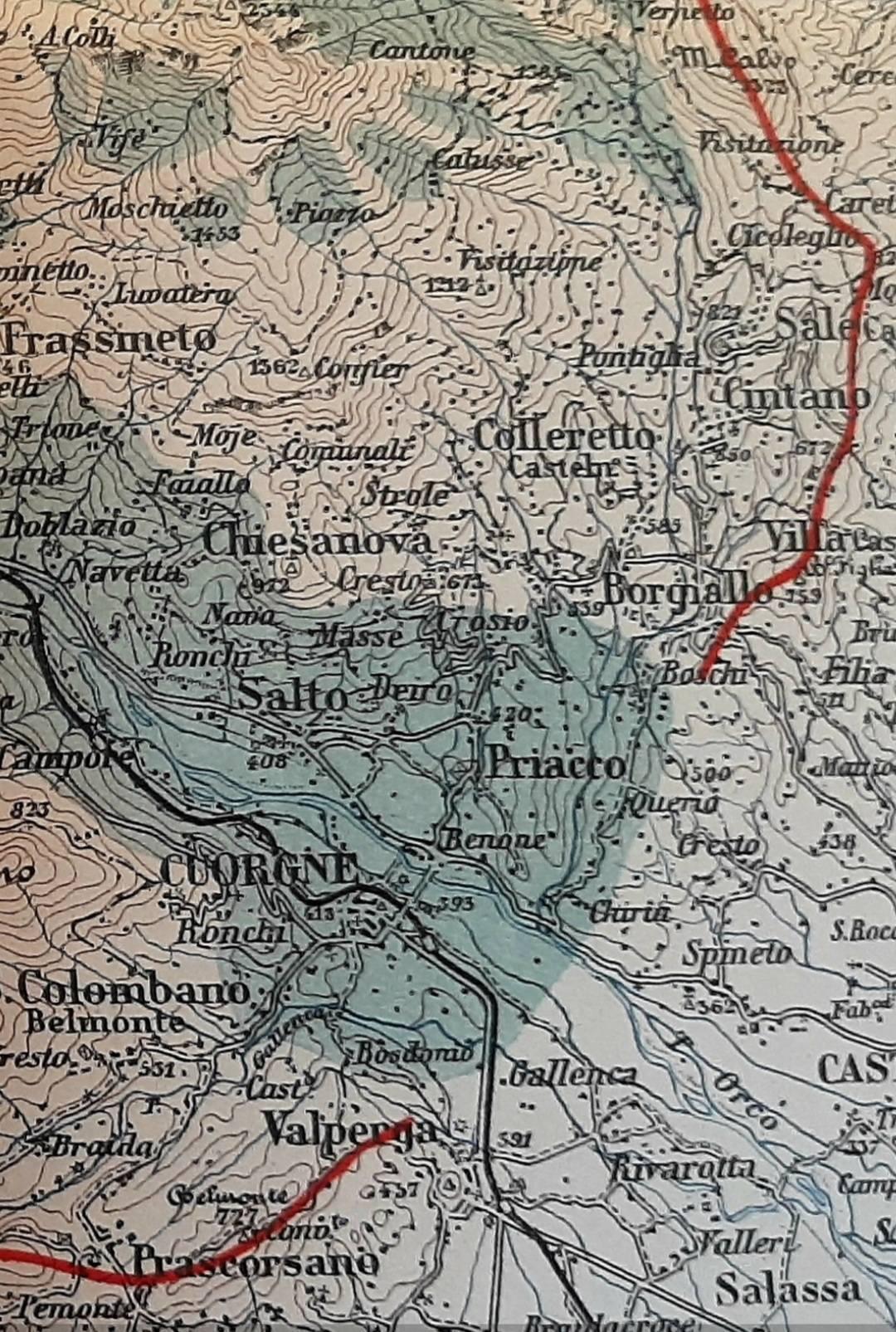
Only a portion of the glacier’s frontal moraine remains visible today, observable from here looking southeast toward Sant’Anna Boschi. Originally, the moraine extended from the slopes of Belmonte to Sant’Anna Boschi in Castellamonte. Most of the debris has been eroded by the Orco River over time, making it less recognizable today.
The attached images show in blue the original extent of the great glacier.
Bibliography
Alpine Geology Book
Caseforti Montane nell’alto Canavese. Quale futuro? – Micaela Viglino Davico
Appunti per una storia di Cuorgnè – Mario Bertolotti
Omaggio a Don Perotti – By friends of Don Attilio