Guardians of the Territory: Between Watch and History
The Importance of Monitoring the Territory
The fortified house of Torre Pietra stands out from other fortified houses in the area for its function as a watchtower. Its strategic position, located at the entrance to the valleys, offers a privileged view of the upper Canavese valley outlet and, in particular, the area of Cuorgnè, with its medieval village towers and the castle of Valperga.
A particularly notable feature is the opening above the window facing the valley: this was intended for carrier pigeons, a fast and effective means of communication at the time. The combination of the wide valley view and the possibility of rapid communication suggests that the tower was continuously manned by a guard.
At the foot of the structure, there is also a contemporary well, an important detail: having water nearby avoided the need to reach streams or fountains hundreds of meters away, ensuring autonomy in case of danger. It is likely that smaller buildings, perhaps made of wood and temporary materials, were located around the tower and served functions related to the agricultural estate. The tower, the well, and these outbuildings could have been enclosed and protected by a wall, ensuring a minimum level of security.
A valuable 19th-century testimony comes from engineer Camillo Boggio, who in his work “Torri, case e castelli nel Canavese” describes and sketches the tower, also mentioning a wall that probably enclosed the surrounding courtyard: “A small wall encloses a short stretch of land around.”
Boggio presents the so-called “Torre della Pietra” as an isolated construction, entirely in stone, structured on four floors, and set on a large rock emerging from the ground. Access to the ground floor was via steps carved into the living rock; the openings, differing in shape and arch detailing, testify to significant craftsmanship. Wooden floors connected the levels via internal wooden stairs, while the roof was a two-sloped slate covering.
The Medieval Canavese Context
To fully understand the strategic role of fortified houses and Torre Pietra, they must be placed within the historical framework of medieval Canavese, a territory marked by continuous conflicts between local powers and overarching authorities.
At the beginning of the 11th century, Canavese was the scene of the Arduinic Wars (1002–1015). Arduino of Ivrea, supported by Canavese lords, northern Italian noble families, and part of the clergy, was crowned King of Italy in Pavia with the Iron Crown, opposing Emperor Henry II. For over a decade he claimed the Italian throne, but in 1014 Henry II entered Italy and gradually regained power in northern Italy. The superiority of imperial forces, combined with the resistance of certain bishop-counts such as the Bishop of Vercelli Pietro and the Bishop of Ivrea Warmondo, forced Arduino to retreat to his native territories. After months of siege at the castle of Sparone, Arduino surrendered in 1015, and Canavese returned under imperial control.
In the following centuries, tensions did not subside. Between the 13th and 14th centuries, violent clashes erupted among the main local noble families. The so-called Canavese War (1339–1362) saw the Ghibelline Counts of Valperga opposed to the Guelf Counts of San Martino. The chronicler Pietro Azario, in De Bello Canepiciano, also mentions the “Castrum Perticae,” identified with the fortified house of Pertia, describing it as a nearly legendary stronghold and even linking Pertia to Arduinic events two centuries earlier. He reports that it could be defended by only a few armed men due to a controlled passage guarded by a tower.
A few decades later, the popular Tuchinaggio revolt followed. The communities of Cuorgnè and the surrounding valleys rose up against local lords, exhausted by years of wars, abuses, and growing taxation. Their demands were clear: greater autonomy, recognition of municipal statutes, reduction of tributes, and especially the right to pass property to female heirs. Without male heirs, properties reverted to feudal lords, causing the ruin of entire families.
The revolts ended with the intervention of Amadeus VI of Savoy, the Green Count, who consolidated Savoy influence in the area. The communities of the Orco, Soana, Valchiusella, and Valle Sacra valleys, together with Cuorgnè, had to pay significant reparations. From that moment, the Savoy dynasty became the dominant power in the territory, though Piedmont continued to be involved in conflicts, including occupations and wars by French and Spanish troops.
A Post in a System of Control and Defense
Fortified houses were part of a complex system dependent on valley-bottom castles, acting as posts where feudal lords, through their vassals, collected tributes in kind and exercised control over agro-pastoral estates. In this context, castles such as the Castle of Salto, the castles of Pont Canavese, or the Castle of Sparone formed the backbone of feudal rule, with fortified houses as extensions spread throughout the territory.
The preservation of alpine fortified houses in Canavese is vital, not only to fully understand medieval events and pass down their memory. Each fortified house tells a shared story of alpine communities, recounts the history of our ancestors, and at the same time narrates the history of its territory. Even today, centuries later, the places where these structures stand speak of the lives and needs of their inhabitants and lords.
They are not only architectural treasures of history and identity for the communities that safeguard them, but can also serve as true tourist attractions, enhancing the entire territory.
We invite you to visit all the Canavese fortified houses, admire them, immerse yourself in the surrounding nature, and enjoy the history and beautiful land that deserves to be valued.
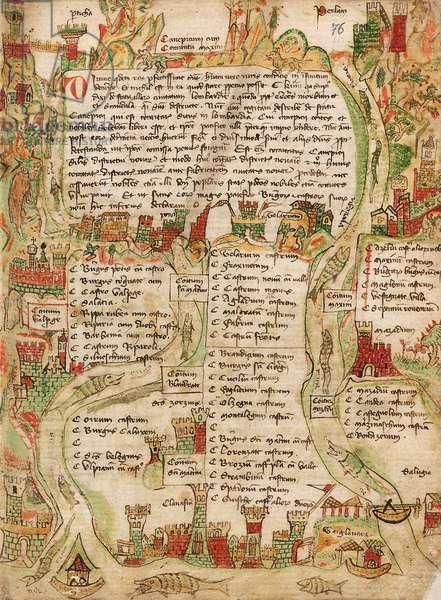
Illustration of the Canavese castles, contained in the manuscript of Pietro Azario. On the left, in the middle of the image, there is a list of castles including those of Pont, Cuorgnè, Valperga, and Salto.
Bibliography
Appunti per una storia di Cuorgnè - Mario Bertolotti
Una Casaforte della Montagna Canavesana: Il “castello” di Pertica - Angelo Paviolo
Caseforti Montane nell’alto Canavese. Quale futuro? Micaela Viglino Davico
L’uomo del Medio Evo - Fernando Vittorino Joannes
Breve storia del Piemonte - Pier Angelo Chiara
Arte Medievale in Canavese - Franco G. Ferrero, Enrico Formica